Introduction
Cloud spending is skyrocketing, bringing added concern for the cloud's environmental impact.
As organizations look to make their cloud investments more efficient, FinOps has become the go-to method for cost control.
But there’s a new approach, GreenOps, that applies a similar accountability framework to carbon emissions.
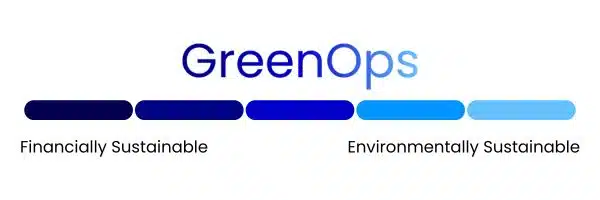
Both practices rely on visibility, clear metrics, and informed decision-making, yet their ultimate goals differ: FinOps is about saving money while GreenOps is about saving the planet.
In this post, we’ll look at how they overlap - and why combining them can help you optimize for both cost and carbon.
🧠 Need to brush up on your jargon? Head over to our FinOps glossary.
Where FinOps and GreenOps Overlap
FinOps brings financial accountability to the cloud, while GreenOps focuses on reducing carbon footprints.
Surprisingly, they share key methods and objectives. Both require visibility into cloud usage and costs, along with clear metrics to drive better decisions. Whether you’re tracking dollars or CO₂, the process is similar: identify inefficient workloads, optimize resources, and repeat.
A prime example is overprovisioned instances - they cost extra money and burn unnecessary energy. By continuously “right-sizing” those instances or turning them off when not in use, you cut both costs and emissions.
This common ground of efficiency means cloud & finance teams, DevOps, and sustainability officers should work together. After all, the same data that informs your cloud bill can often be extended to measure environmental impact.

Key Differences
While FinOps and GreenOps rely on similar processes (visibility, metrics, and continuous optimization), they diverge when it comes to their ultimate objectives and key stakeholders:
Primary Goal
- FinOps seeks to optimize cloud costs and ensure predictable spending.
- GreenOps aims to reduce carbon emissions, guided by sustainability targets and ESG commitments.
Stakeholder Focus
- FinOps typically involves CFOs, finance teams, and DevOps engineers - anyone responsible for controlling cloud budgets.
- GreenOps brings in sustainability officers, ESG teams, and environmentally aware customers concerned with an organization’s environmental footprint.
These differing motivations mean that while the how (continuous optimization, data-driven insights) is the same, the why (financial vs. ecological accountability) and the who (finance vs. sustainability) can vary significantly.
Why They’re Better Together
When cost and carbon are measured side by side, organizations gain a more holistic view of inefficiencies.
By right-sizing workloads and eliminating waste, you save money and shrink your carbon footprint - an efficiency multiplier.
Plus, as governments and investors sharpen their focus on environmental impacts, combining FinOps and GreenOps ensures you’re prepared for Environmental, Social, and Governance (ESG) mandates and emerging compliance requirements.
Ultimately, organizations that treat financial and environmental metrics with equal importance can improve their bottom line and reputation.
🥵 Struggling to implement FinOps in your organization? This guide will help you.
Simple Steps to Combine FinOps & GreenOps
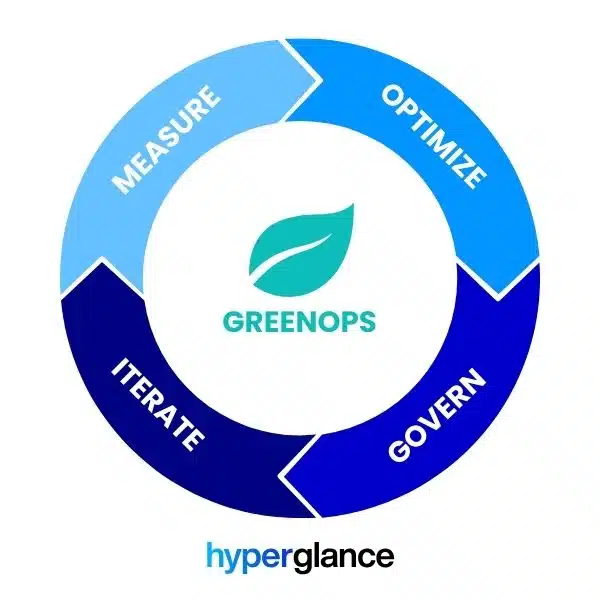
- Measure: Start by tracking both cost and carbon. Many cloud providers offer calculators that convert usage data into CO₂ estimates, so you can view expenses and emissions together.
- Optimize: Apply the same best practices that cut costs - like rightsizing or shutting down idle workloads—to reduce emissions. Consider region selection, opting for data centers powered by renewable energy.
- Govern: Form a cross-functional task force - finance, DevOps, and sustainability. Set shared targets (e.g., “reduce spend by 10% and emissions by 15%”) and hold regular checkpoints to track progress.
- Iterate: Continuously refine your strategies. Analyze data to spot new efficiencies, roll out improvements, and repeat. This cycle ensures you’re always optimizing for both financial health and environmental impact.
Conclusion
By treating cost savings and carbon reduction as two sides of the same coin, your organization can drive meaningful change on both the balance sheet and the environmental impact front.
Bringing FinOps and GreenOps together doesn’t just cut waste. It builds resilience against shifting regulations, enhances your brand’s reputation, and aligns teams around a shared vision of responsible cloud usage.
The path forward is clear: start small by measuring carbon footprints alongside costs, celebrate the quick wins, and keep iterating toward a more sustainable, cost-effective future.
Why Teams Choose Hyperglance in 2026
Hyperglance is a strong fit when cost data alone doesn’t give your team enough context.
That often happens when teams are asking questions like:
- What is running across our cloud estate?
- Who owns this resource?
- Why did this cost change?
- What else depends on it?
- Is it safe to clean up?
- Which policy, security, or compliance issue needs attention?
- Can we route this to the right owner or trigger an approved action?
We help teams connect cloud cost to infrastructure context across AWS, Azure, Google Cloud, and Kubernetes. That means FinOps, CloudOps, platform, security, and leadership teams can work from the same view.
Hyperglance is especially useful for mid-market, enterprise, MSP, public sector, and regulated teams where ownership, governance, automation, and data control matter.
What You Can Do With Hyperglance
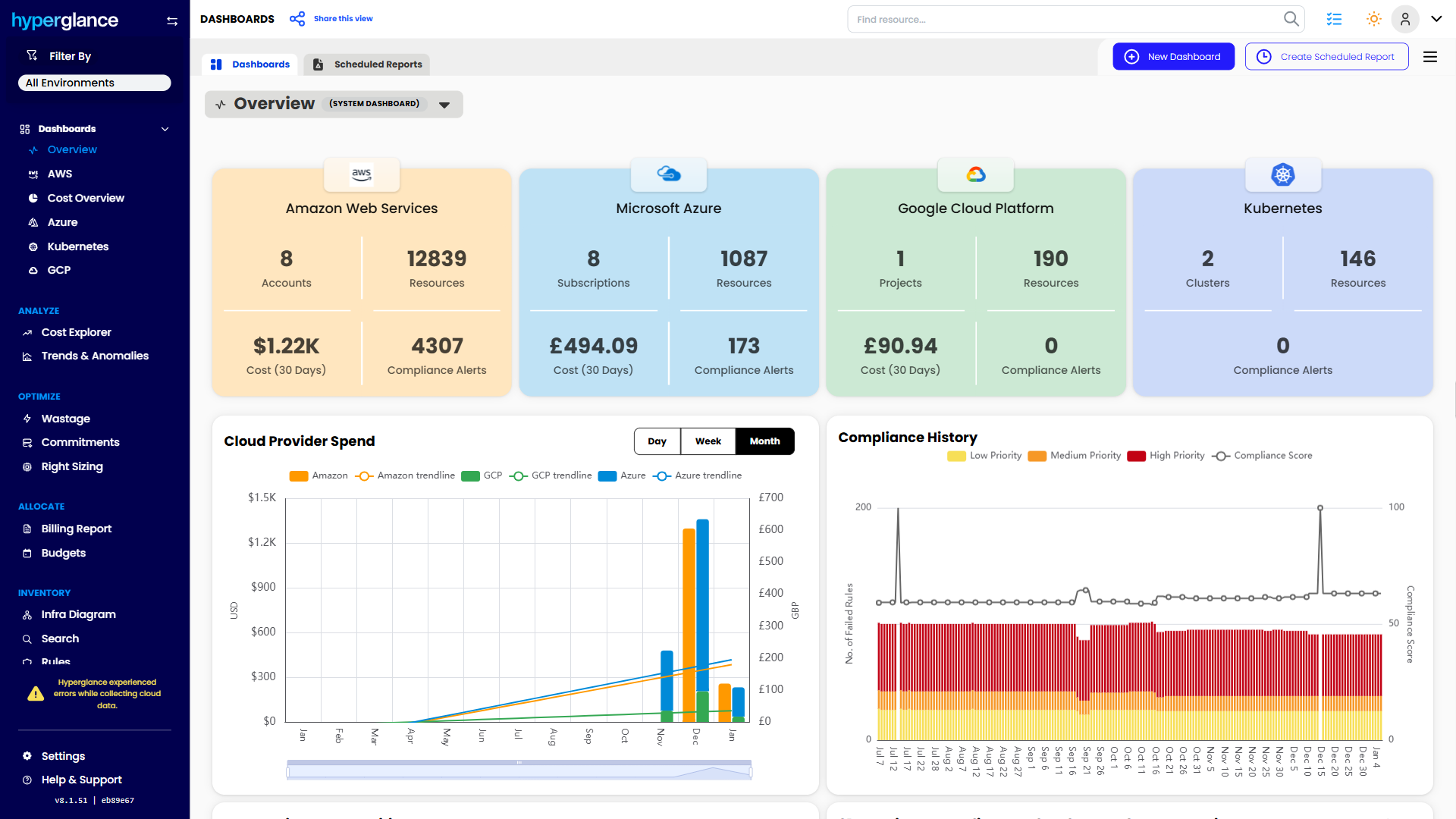
- See cost, resources, relationships, and ownership in one place
- Visualize cloud architecture with interactive diagrams
- Find waste, policy issues, and cost anomalies faster
- Route findings to the right team through existing workflows
- Use no-code automation for approved fixes
- Run Hyperglance in your own environment when data control matters
Want to see where Hyperglance fits in your FinOps stack?
Explore the product, start a free trial, or book a demo with the team.

About The Author: Stephen Lucas
As Hyperglance's Chief Product Officer (CPO), Stephen is responsible for the Hyperglance product roadmap. Stephen has over 20 years of experience in product management, project management, and cloud strategy across various industries.