We’re pleased to share that Hyperglance has been named Cloud FinOps Optimisation Platform of the Year 2026 in Corporate Vision’s Technology Excellence Awards.
The awards recognize technology companies based on factors including innovation, industry impact, client satisfaction, and social responsibility.
For us, the award reflects a simple idea that has shaped the development of Hyperglance:
Cloud cost data becomes much more useful when you can see what sits behind it.
FinOps Needs More Than Another Cost Chart
Most cloud teams aren’t short of billing data.
AWS, Azure, and Google Cloud all provide cost tools. Many organizations also have dedicated FinOps platforms, reporting dashboards, spreadsheets, and internal processes.
But a cost line rarely tells you everything you need to know.
Suppose an underused resource appears to be costing $2,000 each month. Before anyone changes or removes it, the team still needs to answer questions such as:
- What workload does it support?
- Who owns it?
- What other resources depend on it?
- Is it part of a production or recovery process?
- Does it have security or compliance findings attached?
- Is the potential saving worth the operational risk?
That's where cloud cost optimization often becomes difficult.
The recommendation might be easy to generate. Understanding whether it is safe and worthwhile to act on is the harder part.
Connecting Cost With Cloud Context
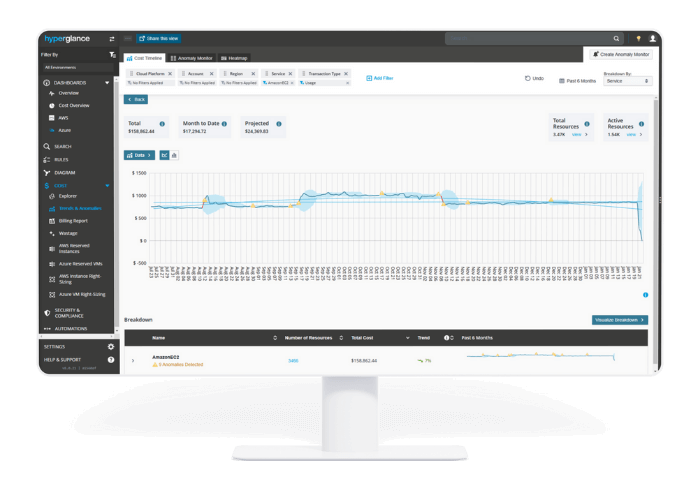
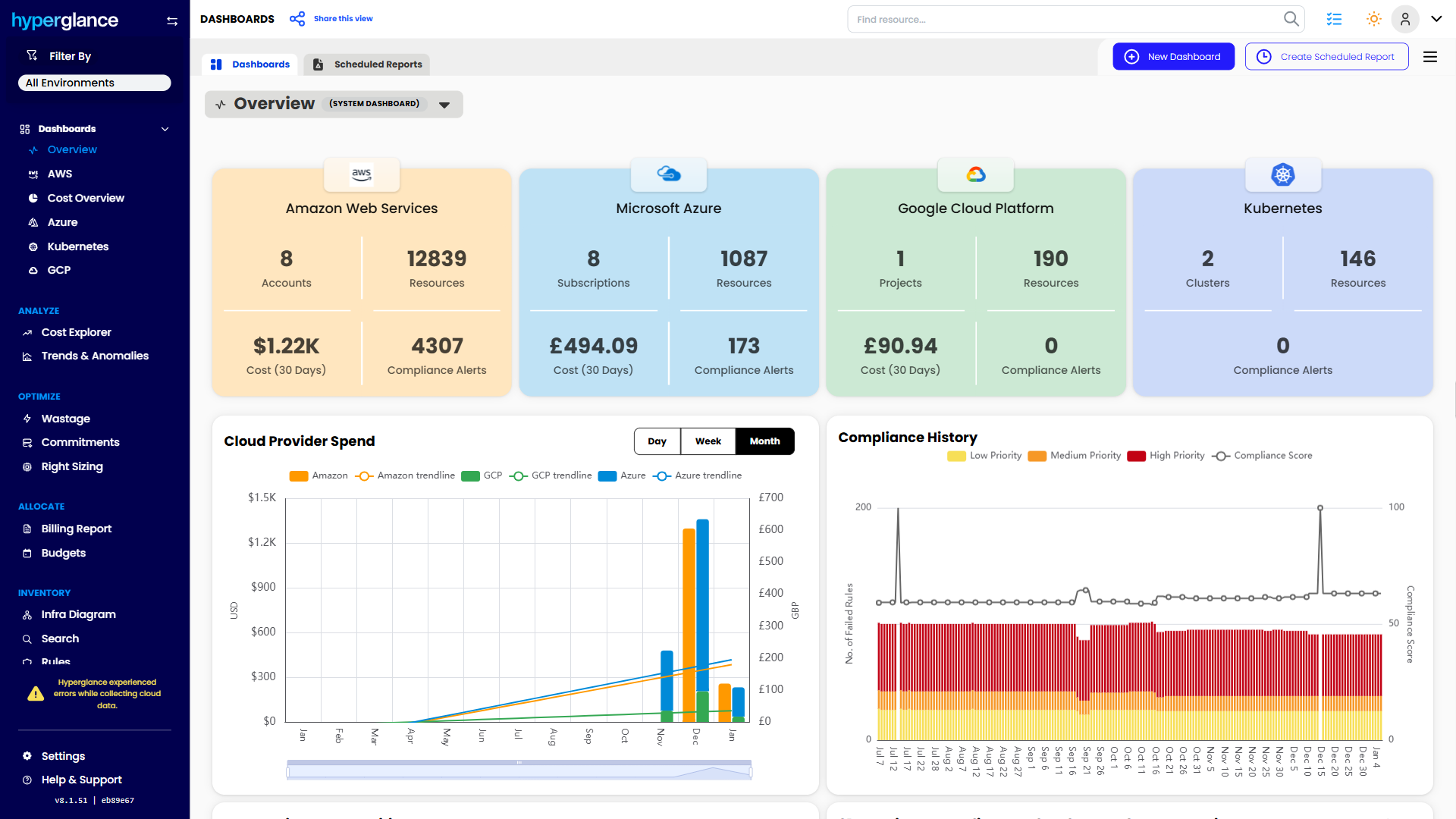
Hyperglance brings cost data together with live cloud inventory, architecture relationships, ownership information, security findings, compliance checks, and automation.
This helps FinOps, cloud, platform, and security teams investigate questions such as:
- Why did our cloud bill change?
- Which resources are driving the increase?
- Who is responsible for this spend?
- Which unused or underused resources need attention?
- Are these recommendations safe to act on?
- How should costs be allocated between teams, services, or customers?
- What needs to happen next, and who should own it?
Teams can explore and report on cloud costs, identify potential waste, analyze spend by tags, track budgets, investigate anomalies, and review forecasts.
But the value doesn't stop at the cost report.
They can also see the resources behind the numbers, understand how those resources relate to the wider environment, check ownership and risk context, and route appropriate actions into existing workflows.
That makes it easier to move from “we found a saving” to “we understand the impact and know what to do next.”
Built for Complex Cloud Environments
Hyperglance supports:
- AWS
- Microsoft Azure
- Google Cloud
- Kubernetes
- AWS GovCloud
- Azure Government
It connects agentlessly and runs inside the customer’s own environment.
This self-hosted approach gives organizations more control over deployment, access, and cloud data handling. That can be particularly important for government, defense, financial services, healthcare, critical infrastructure, and other organizations where sensitive cloud information cannot simply be sent to another SaaS platform.
Hyperglance can help teams:
- Explore multi-cloud costs and usage
- Find unused and underused resources
- Review rightsizing recommendations
- Track budgets, anomalies, and forecasts
- Analyze tagged spend and allocate costs
- Maintain a live inventory of cloud resources
- Visualize architecture and resource relationships
- Identify security and compliance findings
- Create custom rules, alerts, and automated actions
- Connect workflows with Jira, ServiceNow, and Slack
The aim is not to automate every cloud decision blindly.
It is to give teams enough context to make better decisions, then make the appropriate next action easier to manage.
Recognition for the Work Behind the Platform
This award belongs to the people who have helped shape Hyperglance over many years.
That includes our team, who continue to develop the platform around the reality of large and complicated cloud estates.
It also includes our customers, whose questions, constraints, and operational challenges influence what we build.
Their environments remind us that cloud waste is not always obvious waste. Tags do not always tell the full story. Recommendations need context. And the safest action is usually the one supported by a clear understanding of ownership, architecture, cost, and risk.
We’re proud to see that approach recognized by Corporate Vision.
And we’ll keep working on the same problem: helping teams understand what is running across their cloud environments, what it costs, who owns it, what needs attention, and what can safely change.
See Hyperglance in Your Own Environment
Hyperglance can be installed in around 12 minutes, giving you a private, self-hosted view of your AWS, Azure, Google Cloud, or Kubernetes environment.
Start a free trial or arrange a technical walkthrough to see how Hyperglance connects cloud cost with ownership, architecture, risk, and action.
Why Teams Choose Hyperglance in 2026
Hyperglance is a strong fit when cost data alone doesn’t give your team enough context.
That often happens when teams are asking questions like:
- What is running across our cloud estate?
- Who owns this resource?
- Why did this cost change?
- What else depends on it?
- Is it safe to clean up?
- Which policy, security, or compliance issue needs attention?
- Can we route this to the right owner or trigger an approved action?
We help teams connect cloud cost to infrastructure context across AWS, Azure, Google Cloud, and Kubernetes. That means FinOps, CloudOps, platform, security, and leadership teams can work from the same view.
Hyperglance is especially useful for mid-market, enterprise, MSP, public sector, and regulated teams where ownership, governance, automation, and data control matter.
What You Can Do With Hyperglance
- See cost, resources, relationships, and ownership in one place
- Visualize cloud architecture with interactive diagrams
- Find waste, policy issues, and cost anomalies faster
- Route findings to the right team through existing workflows
- Use no-code automation for approved fixes
- Run Hyperglance in your own environment when data control matters
Want to see where Hyperglance fits in your FinOps stack?
Explore the product, start a free trial, or book a demo with the team.
About The Author: Stephen Lucas
As Hyperglance's Chief Product Officer (CPO), Stephen is responsible for the Hyperglance product roadmap. Stephen has over 20 years of experience in product management, project management, and cloud strategy across various industries.