FinOps: An Evolving Discipline
Technology spending is getting more complex every year.
Between public cloud, SaaS tools, and now generative AI, it’s easy for costs to spiral. That’s why a new discipline has emerged to bring clarity and control: FinOps.
FinOps started as a way to manage unpredictable cloud bills, but it’s grown into something much bigger: a clear framework for managing all technology spend.
In this guide, we’ll walk you through the fundamentals and the new updates in the 2025 FinOps Framework, so you can approach your cloud costs with confidence.
We also recommend exploring our guide to cloud tagging to get a head start on foundational FinOps practices.
What is FinOps? A Modern Definition.
FinOps is a term coined by the FinOps Foundation. The FinOps Foundation defines FinOps as “an operational framework and cultural practice which maximizes the business value of technology, enables timely data-driven decision-making, and creates financial accountability through collaboration between engineering, finance, and business teams.”
FinOps = Finance + DevOps
At its core, FinOps isn't just about cutting costs. It's about maximizing the value you get for every dollar spent on technology.
While the discipline was born from the challenges of unpredictable cloud billing, its scope has expanded to include SaaS, AI, and other critical technology investments.
It's now a practice that breaks down the traditional silos between finance, engineering, and business to drive smarter, more collaborative spending decisions.
This new era of cloud financial operations is crucial for modern businesses.
🧠 Need to brush up on your jargon? Head over to our FinOps glossary.
The FinOps Foundation
The FinOps Foundation, a program of The Linux Foundation, is dedicated to helping people who practice cloud financial management.
The foundation has over 23,000 individual members spanning over 10,000 businesses. It provides a wide variety of FinOps training and certifications.
If you'd like to know more about the FinOps Foundation, including its mission, structure, and staff, visit FinOps.org.
What Else is FinOps Known As?
FinOps is attributed to the FinOps Foundation, but it wraps in other concepts and disciplines. These include Cloud FinOps, Cloud Financial Management (CFM), Cloud Financial Engineering, Cloud Optimization, Cloud Cost Management, Cloud Cost Optimization, Cloud Financial Optimization, and Cloud Cost Management & Optimization (CCMO).
In the past, it's also been known as 'Cloud Financial Operations'. That's fallen out of favor with the FinOps Foundation because it was commonly confused with 'Financial Operations' (a separate role that already exists in Finance teams).
Why FinOps Matters in 2025
The need for FinOps has never been greater.
Cloud spend is projected to reach over a trillion dollars by 2026, and a significant portion of that, around 30% is wasted. This waste comes from idle resources, inefficient architecture, and a lack of clear ownership.
Organizations are under intense pressure to demonstrate the ROI of their technology investments.
FinOps turns technology from a potential cost center into a powerful value generator.
By implementing FinOps cloud cost management, teams can gain control over their budgets, accelerate innovation, and align their spending directly with business outcomes.
The FinOps Framework 2025: Structure & Components
The FinOps Framework provides a structured approach to implementing FinOps for cloud cost management.
The 2025 version has evolved to be more inclusive and adaptable, offering a comprehensive FinOps framework overview that addresses the full spectrum of technology spend.
Here are the 7 key components of the updated framework:
- Principles
- Scopes
- Personas
- Phases
- Maturity Model
- Domains
- Capabilities

Source: The FinOps Framework by FinOps Foundation
1. Principles
Initially, a book announced at CloudyCon in 2019, they were originally put together with AWS FinOps in mind. The 6 principles remain foundational but have been updated to reflect modern realities such as decentralized ownership, faster decision-making, and the shift to variable-cost models.
These core principles of FinOps are the cornerstone of the practice:
- Teams need to collaborate: The most effective FinOps practices occur when finance, engineering, product, and business teams work together in near real-time.
- Business value drives all technology decisions: Instead of just focusing on raw spending, decisions are made based on the value and impact they create for the business.Everyone takes ownership of their technology usage: Accountability for usage and cost is decentralized, so engineering and product teams own their own spending.
- FinOps data should be accessible, accurate, and timely: Teams need fast, reliable access to their cost data to make informed decisions.
- A centralized team drives FinOps: A dedicated team promotes FinOps best practices and handles complex rate optimization and negotiations, freeing engineers to focus on their core work.
- Embrace the variable cost model: The flexibility of the cloud and other consumption-based technologies is an opportunity for innovation, not just a liability to manage.
These 6 principles of cloud FinOps are crucial for building a successful practice.
2. Scopes
Scopes are a major new element in the 2025 framework.
They allow organizations to segment their FinOps practice by specific areas of technology spend. This ensures teams can focus on the nuances of each domain instead of applying a one-size-fits-all approach.
Examples of Scopes include:
- Public Cloud: AWS, Azure, GCP resources and infrastructure services.
- SaaS: Software licensing, subscriptions, and per-user or consumption-based SaaS tools.
- Data Clouds: Platforms like Snowflake, Databricks, or BigQuery.
- Generative AI: Spend related to training and running AI/ML models, API call usage, and GPU-based infrastructure.
This granular approach allows for more targeted measurement and enables you to engage the right personas for each specific area of spending. For example, your GenAI team will care about different metrics than your core cloud infrastructure team.
3. Personas
Personas define the roles and responsibilities of individuals involved in FinOps. The 2025 framework broadens this beyond just Finance and Engineering, recognizing that FinOps success requires collaboration from the entire business.
- Core Personas: Leadership, Finance, Engineering, and Product teams who directly influence or control spend.
- Allied Personas: Sustainability, IT Asset Management (ITAM), Procurement, and Security, who provide key support and alignment.
Each persona has defined responsibilities, decision-making authority, and expected outcomes within the framework. Understanding these roles helps define FinOps governance and ensures everyone knows their part in the process.
🎧 Treat your ears to our list of the best FinOps podcasts
4. Phases
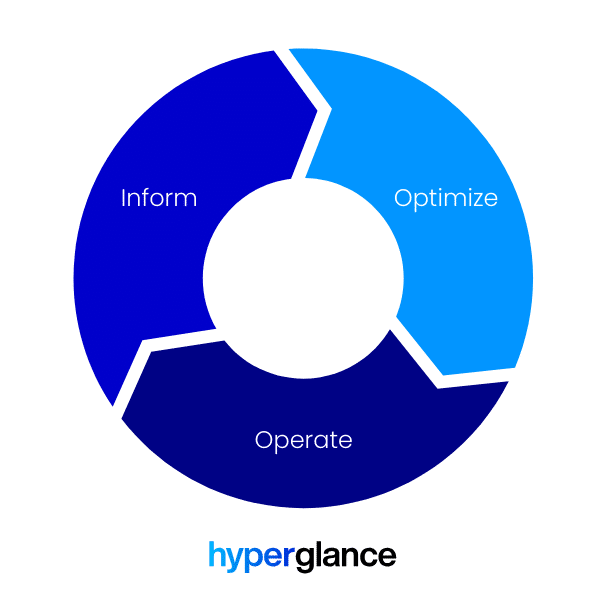
The familiar three phases of the FinOps lifecycle remain central in 2025, but now emphasize iterative maturity within each Scope:
- Inform: This is all about visibility. Teams focus on gathering and analyzing data on technology costs, usage, and efficiency. This phase involves creating accurate FinOps cost allocation and FinOps reporting, establishing budgets, and building shared dashboards so everyone understands where money is being spent.
- Optimize: In this phase, teams use the data from the Inform phase to take action. This includes right-sizing underutilized resources, modernizing architecture, and leveraging discounted purchasing options like Reserved Instances (RIs) and Savings Plans. The goal is to maximize the value you get from your technology investments using proven cloud cost efficiency strategies.
- Operate: This is the phase of continuous improvement. Organizations implement governance policies, monitor compliance, and automate processes to ensure best practices become a natural part of daily operations.
This lifecycle is a journey, and most organizations will be at different stages in each phase. A Crawl-Walk-Run maturity model helps teams set realistic goals and celebrate small wins as they progress.
5. Maturity Model
The FinOps maturity model is no longer a single score. Instead, the 2025 framework measures maturity (Crawl > Walk > Run) per Scope and per Capability.
This granular approach allows organizations to:
- Benchmark performance in different spend categories.
- Identify targeted areas for improvement.
- Track progress within specific teams or functions.
This shift helps avoid the misconception that FinOps maturity is a one-time milestone, instead positioning it as an evolving journey.

6 & 7. Domains & Capabilities
All FinOps work in the framework is now grouped into 4 Domains, each supported by 22 Capabilities that represent specific areas of practice.
Each domain represents an area of knowledge and activities performed by every organization. Domains all relate directly to Capabilities (see below).
The domains are all related to each other and provide a high-level overview of the functional tasks and processes needed to run a best-in-class FinOps practice.
A) Understanding Usage & Cost
This focuses on comprehensively understanding an organization's cloud usage by gathering necessary data on costs, usage, observability, utilization, and sustainability. It defines the processes for categorizing, allocating, and reporting cloud costs, ensuring this information is accessible for all FinOps activities.
The following processes provide clarity on categorizing, allocating, and reporting cloud costs across the organization:
- Data Ingestion
- Allocation
- Reporting & Analytics
- Anomaly Management
B) Quantify Business Value
Organizations develop Capabilities to link cloud usage and cost data with the business value it generates, ensuring transparency and alignment with expectations.
Activities include mapping costs to budgets, forecasting with historical and future data, establishing and measuring KPIs, and benchmarking across teams and organizations.
Key activities include:
- Planning & Estimating
- Budgeting
- Unit Economics
- Forecasting
- Benchmarking
C) Optimize Usage & Cost
This domain emphasizes cloud efficiency, ensuring resources are used only when valuable and purchased at the lowest acceptable cost to meet organizational goals. Efficiency is measured in various ways, including monetary cost, carbon usage, and traditional IT metrics. Capabilities include managing resource types, timing, and costs, modernizing architecture, considering sustainability, and using licensed and consumption-based SaaS products.
The following areas drive these efficiencies:
- Architecting for Clouds
- Licensing & Saas
- Workload Optimization
- Rate Optimization
- Cloud Sustainability
D) Manage the FinOps Practice
This promotes continuous improvement, aligning people, processes, and technology to adopt FinOps and maximize cloud value. It focuses on effective FinOps operations and enhancing interactions across all business functions to better support cloud usage.
These Capabilities enable organizations to build, operate, and optimize FinOps effectively
- FinOps Practice Operations
- Policy & Governance
- FinOps Assessment
- FinOps Tools & Services
- FinOps Education & Enablement
- Invoicing & Chargeback
- Onboarding Workloads
- Intersecting Disciplines
🤝 Everything you need to know about FinOps-Ops-as-a-Service (FaaS)
The Key Benefits of FinOps
Beyond just saving money, a robust FinOps practice delivers significant business value.
- Improved visibility & accountability: Everyone from the executive team to a single software engineer can see and understand their team's spending. This fosters a culture of ownership and encourages responsible decision-making.
- Cost efficiency & predictability: By eliminating wasted spend and optimizing resource utilization, you can significantly reduce your technology bill. This also makes forecasting more accurate and helps you avoid unexpected budget overruns.
- Data-driven decisions: With timely and accurate data, teams can justify or pivot spending based on real-world ROI. FinOps turns technology spending from an abstract cost into a tangible investment with measurable outcomes.
- Business agility: By giving engineers financial guardrails and real-time data, FinOps accelerates innovation. They can experiment and build new features without worrying about uncontrolled costs, and the finance team has the confidence that spending is aligned with business goals.
📝 If frameworks are important to you, check out our AWS Well-Architected Framework Checklist
Measuring FinOps Success
Measuring FinOps success goes beyond just looking at a lower cloud bill. The 2025 framework introduces a more nuanced approach to metrics, with success being measured per scope and capability.
Some key metrics to track include:
Cloud enablement %
The number of cloud-certified/trained business leaders / the number of cloud learners across the organization
- Crawl: Less than 40%
- Walk: 40-70%
- Run: More than 70%
Cloud allocation %
The % of cloud spend being allocated to the responsible business or product owner
- Crawl: Less than 70%
- Walk: 70-90%
- Run: More than 90%
Cost optimization realized savings %
Total cloud services optimized ($) / total cloud services optimizable ($)
- Crawl: Less than 70%
- Walk: 70-90%
- Run: More than 90%
Annual forecast accuracy %
Actual annual cloud spend ($) / forecast annual cloud spend ($)
- Crawl: Less than 70%
- Walk: 70-90%
- Run: More than 90%
FinOps automation %
Number of automated recommendations implemented / total list of automated recommendations that result in cost savings
- Crawl: Less than 20%
- Walk: 20-50%
- Run: More than 50%
A solid KPI dashboard is essential for visualizing this data, spotting trends, and communicating progress to stakeholders across the organization.
🥵 Struggling to implement FinOps in your organization? This guide will help you.
Choosing a FinOps Tools/Platform
While FinOps is a cultural practice, technology is a key enabler. While every cloud provider offers native tools like AWS Cost Explorer, they often require significant manual effort. The FinOps tool market has matured significantly to fill this gap.
To some degree, these rely on your architecture being well managed (think tagging). To a larger degree, these tools require human effort. Maximizing the value of these tools is challenging.
Best-in-class cost optimization is only possible using third-party tools. Modern leading FinOps solutions go beyond simple cost visualization. When looking for a solution, consider features that align with the current framework, such as:
- Multi-cloud coverage
- Real-time monitoring & alerting
- Pre-defined, customizable rule-based automations
- Visualization of your costs with the ability to overlay them onto a diagram of your architecture
- Reserved Instance (RI) and right-sizing recommendations
- Wastage identification
- Trend analysis & anomaly detection
- Budget management
- Customizable billing reports for chargebacks and showbacks
Remember, a tool is only as good as the process and culture behind it. The goal is to choose a tool that empowers your teams, not one that dictates your practice. A FinOps Certified Platform can give you confidence that a tool aligns with industry best practices.
Getting Started with FinOps in 2025
Ready to begin your FinOps journey? Here's a quick roadmap to get started:
- Assess Your Current Maturity: Use the framework's maturity model to identify where your organization stands today.
- Define Your Scopes: Determine which areas of technology spending are most critical for your business (e.g., Public Cloud and GenAI).
- Establish a Central Team: Create a dedicated team or designate a champion to drive the initiative and provide support.
- Start Small: Begin with foundational practices like standardized tagging and creating shared dashboards.
- Scale Gradually: As your teams mature, introduce more advanced practices like automated rightsizing and budget-based governance.
The journey to FinOps maturity is continuous, but the rewards in terms of cost efficiency, predictability, and business agility are worth the effort.
Key Takeaways
- FinOps aligns technology spend to business value through cross-team collaboration.
- The FinOps Framework 2025 introduces Scopes, updated Principles, and expanded Capabilities to address modern technology spend, including AI and SaaS.
- The practice involves three core phases: Inform, Optimize, and Operate.
- FinOps success is measured by balancing financial metrics with operational and business outcomes.
- Tools are important, but success relies on a shared mindset and well-defined processes.
Why Teams Choose Hyperglance in 2026
Hyperglance is a strong fit when cost data alone doesn’t give your team enough context.
That often happens when teams are asking questions like:
- What is running across our cloud estate?
- Who owns this resource?
- Why did this cost change?
- What else depends on it?
- Is it safe to clean up?
- Which policy, security, or compliance issue needs attention?
- Can we route this to the right owner or trigger an approved action?
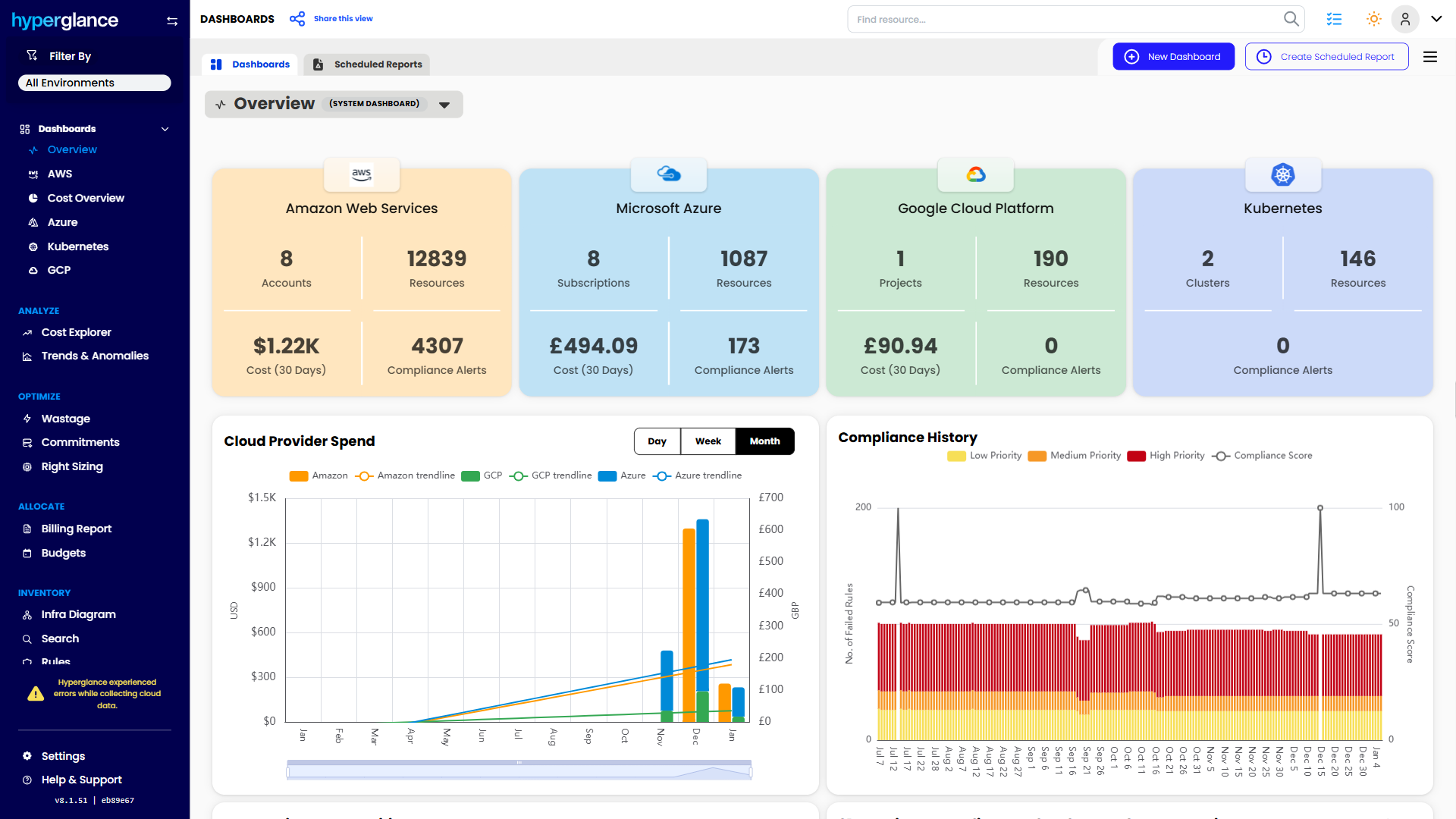
We help teams connect cloud cost to infrastructure context across AWS, Azure, Google Cloud, and Kubernetes. That means FinOps, CloudOps, platform, security, and leadership teams can work from the same view.
Hyperglance is especially useful for mid-market, enterprise, MSP, public sector, and regulated teams where ownership, governance, automation, and data control matter.
What You Can Do With Hyperglance
- See cost, resources, relationships, and ownership in one place
- Visualize cloud architecture with interactive diagrams
- Find waste, policy issues, and cost anomalies faster
- Route findings to the right team through existing workflows
- Use no-code automation for approved fixes
- Run Hyperglance in your own environment when data control matters
Want to see where Hyperglance fits in your FinOps stack?
Explore the product, start a free trial, or book a demo with the team.

About The Author: Stephen Lucas
As Hyperglance's Chief Product Officer (CPO), Stephen is responsible for the Hyperglance product roadmap. Stephen has over 20 years of experience in product management, project management, and cloud strategy across various industries.